

SEARCH
Industry Partners




Prairie Swine Centre is an affiliate of the University of Saskatchewan

Prairie Swine Centre is grateful for the assistance of the George Morris Centre in developing the economics portion of Pork Insight.
Financial support for the Enterprise Model Project and Pork Insight has been provided by:







Improving the Number of Quality Weaned Pigs – Powerpoint Presentation
Posted in: Pork Insight Articles, Swine Innovation by admin on February 13, 2013 | No Comments
As part of a review of future research and development possibilities in the area of swine reproductive biology and breeding herd management (Foxcroft, 2012), a number of key areas of future interest were identified. One centred around the gene x environment interactions that determine the final phenotype of production-level progeny in mature sow populations. Understanding the mechanistic basis for the observed gene x environment interactions that drive “litter of origin” effects on post-natal performance has been an important part of our research program. The outcomes from these studies suggest ways to identify litter phenotypes and to create production strategies to address existing “phenotypic plasticity”. The possibility of using a nutrigenomic approach to offset such programmed effects has also been explored. At a more basic level, the goal is to find genomic/epigenomic markers for the key biological traits that drive these gene x environment outcomes, with the aim of including genetic markers for these component traits in more sophisticated breeding programs that deliver replacement gilts for commercial production.
A second area of focus was driven by recent opportunities, at least in North and South America, to determine individual boar fertility in large commercial boar studs. This constitutes the first step in improving the impact of genetically superior sires on the number, and particularly the quality, of commercial progeny. At the same time, access to fertility data from large populations of terminal-line boars enables association analyses that will hopefully allow genomic and proteomic markers of boar fertility to be identified. A more detailed discussion of recent collaborative studies on boar fertility will be presented by Amanda Minton in Breakout # 11 at this meeting. As part of this74 Foxcroft et al presentation, data from the same collaborative studies will be used to identify the extent to which variability in boar fertility, and current AI practices in the industry, has probably been limiting the performance of outstanding dam-line females.
North American Consumers Want Fat They Can’t See
Posted in: Pork Insight Articles, Swine Innovation by admin on January 25, 2013 | No Comments
Consumers in North America don’t like to see the muscle fat in their meat, but their taste buds actually prefer some intramuscular marbling. In Japan, it is the opposite; there, consumers want to see the fat and they pay a premium for more intramuscular marbling.
To help the pork industry deal with complicated consumer preferences, the Canadian Centre for Swine Improvement is conducting a cross-Canada, three-year evaluation of about 6,000 Duroc pigs so that breeders can select the best candidates to sire the next generation of market pigs.
Brian Sullivan, the Ottawa-based CEO of the Canadian Centre for Swine Improvement, says the evaluations are being done using ultrasound along with software technology developed at Iowa State University. Trained technicians take ultrasound images of the pigs. The images are uploaded into the centre’s database, where they are reviewed using the Iowa State University software to come up with an estimate of intramuscular fat.
Centred on Swine Volume 18
Posted in: Pork Insight Articles, Prairie Swine Centre by admin on January 24, 2013 | No Comments
Individual articles in these issues of Centred on Swine are located in our PorkInsight Database.

- The overall response of piglets to phase one diets during the first two weeks in the nursery is not affected by creep feeding or weaning weight
- Top 10 developments in swine nutrition, 1991 to 2012
- Using ‘translactational analgesia’ to reduce piglet pain at castration
- Early detection and interventions for reducing lameness in gestating sows
- A revolution in feed management is coming to your operations!

Electronic Sow Feeders
Posted in: Pork Insight Articles, Welfare by admin on January 11, 2013 | No Comments
Science of Ethology, Volume 1, Issue 4
The electronic sow feeding system represents the ultimate in the use of technical control to manage sows. The use of electronics to control all aspects of the system is a major shift in the management of sows, somewhat akin to the use of robotic milkers for dairy cows. It requires a significant shift in our approach to managing animals and the daily routine of the barn.
How the System Works
An ESF system generally provides a single (or very few) feeding station(s) for a large group of sows (typically 40-60 sows/station). The sows must eat sequentially, one after the other, from the same station. Once a sow enters the station the entrance gate locks behind her and she is identified by means of a transponder in her ear tag. The computer controlled feeder allots her a specific amount of feed, dropped into the feed bowl over a limited period of time. During the feed drop, and for several minutes afterward, the entrance gate remains locked so that other sows may not enter. The sow may leave at any time, ending the dispensing of feed and unlocking the entrance for the next sow. The computer records the amount of feed that has been dispensed to each sow (not the amount actually eaten), and allocates any undispensed allotment to a subsequent entrance by the same sow that same day, or to her next day’s feed. The system typically cycles on a daily basis, with a new allotment of feed being made available to each sow every 24 hours. As the stockperson will not be present while each sow eats, the system must provide feedback on any sows that fail to eat their allotment each day. This feedback is in the form of an ‘attention’ list available to the stockperson at the end of each 24-hr cycle, and is used to identify animals that may need additional care.
Non-Competitive Feeding Systems: Gated Stalls
Posted in: Pork Insight Articles, Welfare by admin on | No Comments
Science of Ethology, Volume 1, Issue 3
In our previous article, we have defined a non-competitive feeding system as one in which a sow is not able to obtain more feed by winning a fight. Fights may occur in such a system, but the winning sow does not steal food from the loser. This is accomplished by protecting the sow in a fully enclosed stall while she eats. There are two basic types of non-competitive feeding system, the gated stall and the electronic sow feeder (ESF). In an ESF system, there will only be one feeding station for a group of sows. However, in the gated stall system, all of the sows in a group eat at the same time, and there must be a stall for each sow. Gated stalls, or free-access stalls, are the most common system used in several European countries, including Belgium where 31% of farms and 37% of sows use the system. Within that country it is the most popular choice when making conversions (Tuyttens et al., 2011).
2012 Research Results
Posted in: Prairie Swine Centre, Press Releases by admin on December 19, 2012 | No Comments
NUTRITION
Field peas can be incorporated into grow-finish diets, up to 60%, without affecting performance or diet palatability. The usage of peas in swine diets should be based on economics and availability. At current price relationships (Fall 2012) incorporating peas into grow-finish diets would save up to $2.00/hog.
Pigs segregated at nursery exit based on their growth rate from birth (fast, medium or slow growing) will have similar growth and nutrient (protein, lipid, ash) deposition rates during the growing (30 to 60 kg BW) and finishing (90 to 120 kg BW) periods.
There was no interaction between feeding level, energy concentration in the diet and phenotype (pigs selected for differing potential growth rates) for growth or nutrient deposition rates for pigs growing or finishing pigs. The utilization of different feeding programs for pigs segregated into projected growth potential groups in the nursery is not advised.
Dietary net energy (NE) estimated using 1) equations developed in Europe (French or Dutch) based on digestible nutrients, 2) indirect calorimetry, or 3) retained energy (carcass slaughter technique) showed good agreement between indirect calorimetry and the equations, while the NE based on retained energy was typically lower. Diet formulation must use ingredient values derived from one system.
In growing pigs, grams of nitrogen (protein) retained per caloric intake was higher when the energy was derived primarily from starch rather than fat. Nutritionists should consider incorporating starch as a nutrient in their diet formulation matrixes.
We previously reported that feeding creep (supplemental feed in farrowing) was not advantageous. However, we have now shown that only 40 % of piglets offered creep in the farrowing room consume it. Creep feed intake does improve growth weaning weight; we need to find methods to improve the proportion of pigs who consume it. Developing management strategies that improve the number of pigs consumng creep feed (>90%) would result in a net benefit of $.50/pig.
Consumption of creep feed in the farrowing room did correlate with increased consumption of phase 1 diet during the first 24 hours post-weaning. We need to look at solutions which combine behaviour and nutrition to mitigate the post-weaning growth lag.
Adding 8 % spray dried animal plasma to nursery diets containing mycotoxin contaminated wheat (2 ppm deoxynivalenol in final diets) mitigated the negative effects of the mycotoxin. Nutritionists should consider the addition of SDAP to diets for growing pigs if contamination is suspected.
Adding a clay to nursery diets containing mycotoxin contaminated wheat (2 ppm deoxynivalenol in final diets) did not mitigate the effect of the mycotoxin.
Based on all reproductive data for an entire set of omega-6:omega-3 ratio trials, a plant based ratio of 5:1 is optimal. When the ratio was dropped to 1:1 negative effects were observed (reduced piglet performance, reduced sow feed intake in lactation, increased reliance on body fat to provide nutrients in milk). Benefit to the producer would be $.60/pig.
When including omega-3’s (ie. from flaxseed or fish oil) into sow diets, it is important for producers to account for the ratio relative to omega-6 as opposed to formulating rations based on an absolute amount of omega-3.
ENGINEERING
A benchmark survey revealed that groundwater well is the main source of water for many pig barns, at an average usage of 965 gallons per pig produced. Many barns do not keep track of their actual water utility cost; for those few which did, the estimated average water cost was $0.36/pig.
Relative to conventional nipple drinkers, the use of a drinking trough with side panel and constant water level saved significant amount of water (8.175 L/day-pig vs. 6.7 L/day-pig) due to reduced water wastage (3.77 L/day-pig vs. 1.27 L/day-pig), without adversely affecting pig performance.
High pressure washing using a conventional nozzle led to lesser time and water consumption during the cleaning process. High pressure washing in fully slatted concrete flooring can be done without soaking the room.
Compared to current conventional practices, the combination of using a drinking trough with side panel and constant water level for animal drinking and pre-soaking and high pressure washing with conventional nozzle for cleaning can potentially save up to $9.24/pig due to reduced overall water use and accumulated manure slurry.
The use of radiant heater can improve the overall barn energy efficiency as it consumed lesser total energy (both natural gas and electricity) compared to a forced-convection heater system. This type of system will imprive operating costs by approximately $2.00/pig.
The use of radiant heater or forced-convection heater did not significantly influence pig performance (ADG, ADFI, feed efficiency and mortality rate) and indoor air quality. The benefits from the use of radiant heaters can be maximized and its economic feasibility can be improved if such type of heater is used in areas in the barn with high heating requirement and with longer periods of heating demand throughout the year.
Sprinkling canola oil in swine facilities is effective in reducing airbourne dust levels. System would cost approximately $2.70/pig.
In order to develop effective measures in reducing worker exposure, applied measures must reduce the potential of contaminant sources or associated activities to generate emissions, thereby lowering both airborne contaminant levels as well as exposure of the workers to these emissions.
ETHOLOGY
Over 95% of gestating sows in walk-in/lock-in stall housing made use of the free space, over half of them spent less than 5% of their time outside of stalls. Larger, older sows used the free space significantly more than did younger sows, suggesting that younger, subordinate sows may be reluctant to exit stalls due to aggression.
Use of free space in walk-in/lock-in systems is an important factor, as increased activity is thought to improve bone strength, sow longevity and productivity by reducing birthing intervals and crushing of piglets in lactation. Factors found to increase use of the free space include: training of gilts on entry to facilitate their exit from stalls, improving the quality of the free space by including solid floor areas and solid partitions as sows prefer these areas for resting (e.g as found in ‘T’ pens), addition of rubber mats to the free area floors to increase sow comfort, and segregating sows by age and size into low and high parity groups.
A subjective study of loading facilities identified positive and negative factors that influence pigs’ behaviour at loading. Facility design features that promote ease of loading include use of loading rooms near the loadout, wide alleys, separate manways, adequate lighting, even flooring with good traction, low slopes on ramps (<20°), and covered trailer docks.
Handling methods that reduce stress and promote ease of handling at loading include pen-walking or handling of pigs before loading (training), minimal prod use (less that 2x per pig), appropriate use of handling boards, moving group sizes appropriate to the facility design and handler’s skill, and familiarity with behavioural techniques (e.g. using body position to promote movement, providing ‘release’ once pigs are moving).
During transport, pigs stand more in winter than in summer. This is likely to reduce heat loss to the trailer floor. During long trips in winter, this can result in increased energy depletion and fatigue in pigs, as well as production of more meat showing dark, firm and dry (DFD) or red, soft and exudative (RSE) characteristics. Winter transport was also associated with increased metabolic rate (elevated heart rate and body temperature) and increased dehydration.
Transport of pigs during the summer results in a greater risk of death losses due to acute heat stress. The greatest number of losses occurs in the rear trailer compartments. The highest trailer temperatures, body temperatures and heart rates were found shortly after loading.
Implementation of measures to reduce heat stress are most important at loading. For example, truckers should leave the farm as soon as possible after loading and travel continuously for 1-2 hours tp cool pigs before stopping. Load manifests should be completed prior to loading, and loading near midday should be avoided. Loading density should be reduced in problem compartments, and the rear panels of the trailer should be fully perforated to allow maximum air flow.
The effects of long duration transport on pigs are greater in winter than summer, and vary significantly between compartments. Pigs transported 18 h in winter showed elevated body temperatures indicating an increased metabolic rate, and took longer to rest and drank more in lairage, indicating delayed recovery compared to pigs transported for 6 or 12 h.
Sprinkling of pigs on the truck immediately before departure from the farm, and before unloading at the abattoir was found to alleviate heat stress when applied at temperatures >23°C.
Competitive Feeding Systems
Posted in: Pork Insight Articles, Welfare by admin on November 30, 2012 | No Comments
Science of Ethology, Volume 1, Issue 2
We define competitive feeding systems as those in which an animal can obtain more feed by winning a fight. However, this does not necessarily mean that you will observe a lot of fighting in such a system. Often, the majority of fighting will occur within a couple of hours after mixing. Once a sow’s dominance status has been established by aggression (fighting), it is often maintained by very subtle agonistic behaviour. These behaviours include threats through head movements and body posture by the dominant animals, and, for subordinate sows, moving in such a way as to avoid dominant animals. One study even referred to the social order among sows in a group to be one of ‘avoidance’ rather than ‘dominance’ (Jensen, 1982). However, if a sow is able to obtain more feed by any of these means, it is a competitive feeding system. Some feeding systems, such as gated stalls and ESF stations, protect a sow while she is eating and eliminate the possibility of obtaining more feed by fighting. We will discuss these in later articles. In this article we will discuss the ultimate competitive feeding system, floor feeding, and non-gated feed stalls that reduce but don’t eliminate competition.
Competition is a characteristic of the social system within a group of animals. In its simplest form we have dominant/subordinate relationships among the animals. The definition of dominance is that it results in priority of access to limited and defendable resources. Pig producers are generally comfortable with group housing if the resource (feed) is not limited: e.g. finishing pigs fed ad-lib. But sows are almost always limit fed to control their body condition, and so we have the possibility of competition. Our management of competitive systems is such that we attempt to reduce the dominant sows’ ability to control the resource. We do this in two ways: social and physical management. We will look at different competitive systems and how they can be managed most effectively.
FLOOR FEEDING
Dominant sows have a distinct advantage in terms of feed intake and weight gain in floor feeding systems (Brouns and Edwards, 1994). Subordinate sows, who are also usually younger and lighter, will fall behind in body condition and may have to be removed. A ‘relief’ rate of 15% is common when floor feeding. Social management is the primary means of evening out feed intake in floor feeding systems. In non-competitive systems, such as finisher pigs, there is some advantage to having a significant variation in the size of the pigs. This is because the social system actually operates better with some variation, i.e. if there are many individuals of the same competitive status, there will be increased aggression until a hierarchy is established. The opposite is the case when dealing with competitive situations, especially situations of competition over feed. To ensure the most even feed intake among a group of sows, the sows should be as similar as possible, making them equally competitive. This will take the form of sorting sows by parity, weight and body condition. The result is a group of sows having the same feed requirement, and the same potential to compete for it. This sorting within a breeding cohort obviously results in smaller group sizes.
In order to have sows enter the system with similar body condition, it is advantageous to house them in stalls until confirmed pregnant (normally 35 days post-breeding) and feed them to achieve similar backfat levels by that time. Use of such ‘breeding and implantation’ stalls is particularly important for floor feeding systems as excessive competition and poor feed intake during this critical phase can affect reproduction (Spoolder et al., 2009).
In terms of physical management, it is possible to use some dividers within the pen to create several feeding sites. This is only possible with larger groups. In general, the feed should be spread about as much as possible (multiple drop sites), to prevent a sow from defending a large drop of feed.
Large group floor feeding?
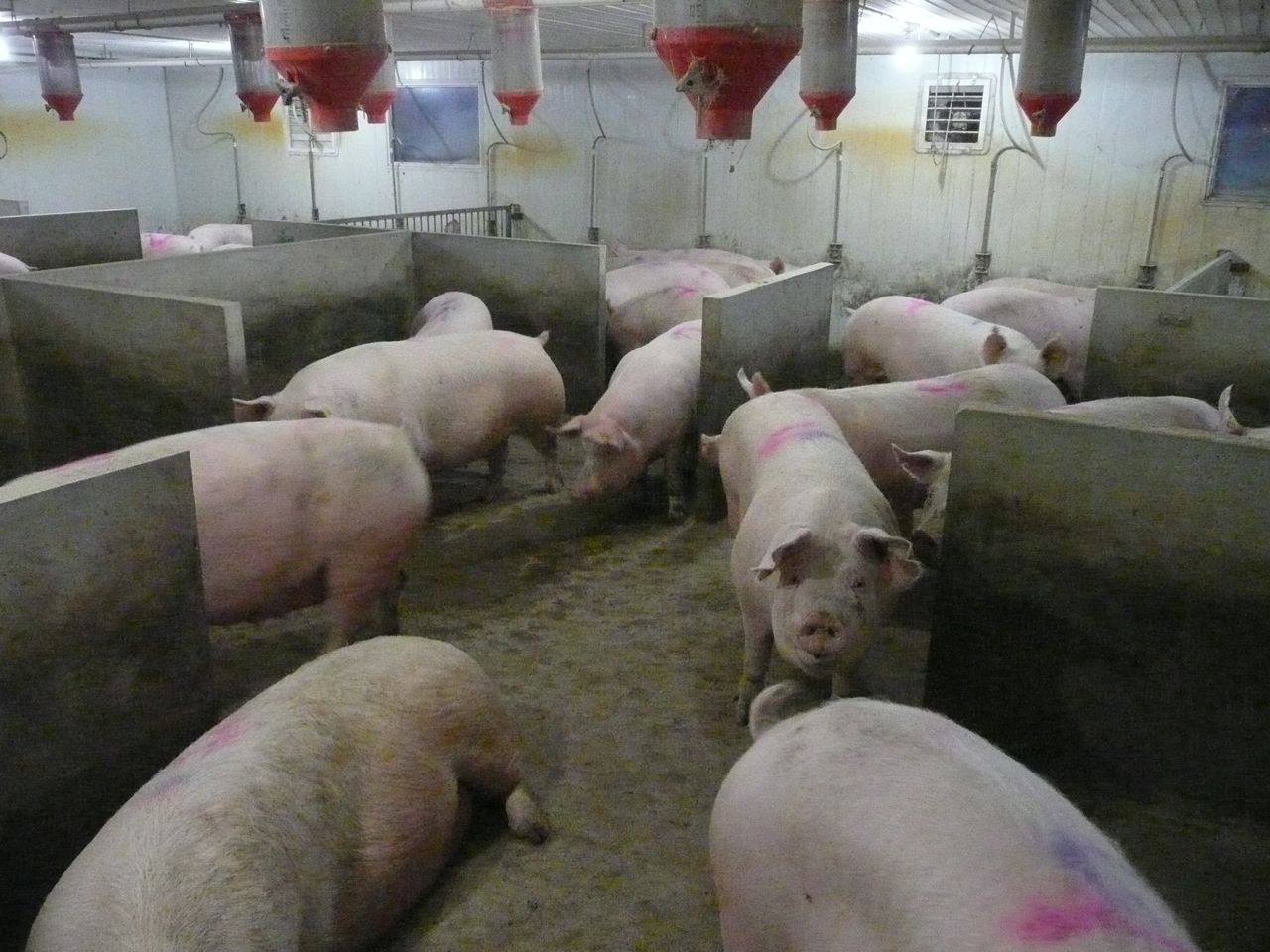
Several farms in Ontario have adopted a novel floor feeding system that differs from most in three ways: the groups are large, and may include sows of different parities; the pen has a number of partial divisions in it that provides some separation of the multiple feeding sites; and, the feed is dropped in several (typically 6) drops per day, spaced 30 to 60 minutes apart. Large, non-uniform groups reduce the social tension in finisher pigs, but are not generally advocated for competitive systems such as gestating sows. The barriers provide sows some physical protection as seen in short-stall systems, but several sows still eat from the same feed drop. The key to the system may be the frequent feed drops that allow subordinate animals to eat from the later drops as the dominant sows feel satiated from eating from the first.
Although several farms are using the system, it has not been studied in comparative tests. As with any floor feeding system, some sows have to be removed. At least one producer does not include gilts with the sows. The system as a whole, and particularly the multiple feed drops, should be studied before being adopted. However, it illustrates that floor feeding can be managed in many different ways.
Using bulky, high fibre feed will extend the feeding time and reduce the incidence of stereotypic behaviours, but may contribute to more aggression. Similarly, feeding on a strawed floor will extend feeding periods and increase aggression (Whittaker et al. 1999).Feeding a bulky diet ad-lib allows the subordinate sows to avoid peak feeding times and consume normal levels of feed (Brouns and Edwards, 1994), but it must be bulky enough to limit total energy intake.
Keys to successful floor feeding
-
Sort sows by parity, size and body condition.
-
Use the time in breeding/implantation stalls to even out body condition.
-
Spread feed as evenly as possible.
-
Use dividers within the pen.
-
Remove sows that fall behind.
Providing Protection: Non-Gated Stalls
As an alternative to floor feeding, producers should consider the use of feeding stalls in order to provide protection during eating. In this article we will only discuss non-gated (no back gate) systems, as gated stalls will be discussed as a type of non-competitive feeding system in a future article. Recalling the earlier statement on dominance, we note that dominant animals will exert themselves when resources are both limited and defendable. Defendable refers to the ability of the dominant animal to control more than their share of the resource. Non-gated stalls prevent the dominant animal from monopolizing the feed by allowing the subordinate animals to defend a small portion of the total feed available, that is, their share of the feed. However, with enough effort dominant sows will be able to force a subordinate out of a non-gated stall and thereby obtain more feed.
Two Types of Problems
If the performance of your sows in a competitive feeding system is below your expectations, it is very easy to blame the feeding system. That is not always the problem. Two types of stressors can affect animals in groups: competitive and general. To determine which is most likely within your system you need to determine the demographics of the problem. If the problem affects younger, smaller animals more than larger, older animals, that is, an uneven distribution, it is likely a competitive issue. A common problem in competitive feeding systems is the fat sow/ thin sow syndrome, in which smaller sows get thinner and larger sows get fatter. In this case you should attempt to reduce the effect of competition during feeding. However, if your problem is just as common among larger sows as it is among smaller ones, then it is likely a general stressor that is affecting all of the pigs similarly. Examples of these types of stressors would include high temperatures, poor flooring, poor air quality or space restriction. The solution to these problems is quite different to that of a competition problem. In some instances, the problem may involve both general and competitive stress. For example, if poor flooring results in 10% of the sows becoming lame, evenly distributed across all sizes, the smaller lame sows may be at a greater disadvantage when they try to compete for feed. If you can identify that lameness was the initial problem, and improve the flooring, you will be more successful in correcting the subsequent problem caused by competition.
Non-gated systems should make use of the social management techniques outlined for floor feeding (e.g. sorting by size and body condition). However, these systems also use physical methods to interfere with dominant sows attempting to displace subordinates from their feed. Non-gated stall systems use feed troughs so that the feed can be delivered and limited to a defined area. These troughs are divided so that individual allotments of feed are dropped into each division. Stalls are added to these divisions to provide protection to each sow as she eats. The longer the stalls, which typically vary from shoulder length to full body length, the less aggression and more even intake of feed (Barnett et al., 1992, Andersson et al., 1999). Floor feeding gives a distinct advantage to the dominant sow. Partial stalls reduce this advantage and allow the subordinate animals to spend more time eating and achieve a higher intake.
Shorter stalls, such as those that only extend back to the animal’s shoulders, will not fully protect a subordinate animal. In systems with these stalls, it is common to see cuts and scratches on the sides of the lower ranking individuals where the dominant sows have attempted to displace them from the feed trough. Longer stalls will provide more protection, but some displacement may still occur. If longer stalls are better, then why would a producer use short stalls? It is a balance between protection during feeding and the amount of space the system requires. Group housed sows should have a sufficient amount of free space (outside of the stall) to move about freely. If a producer uses long stalls, additional space is necessary behind the stalls to provide this loafing area. Longer stalls also represent a greater capital expense, in addition to the increased floor space.
Are there other means to reduce aggression and displacements among sows in non-gated stall systems? There appear to be at least two: increasing the eating speed of the sows will reduce the time required to consume their feed and decrease feeding associated aggression (Andersson et al., 1999). One of the easiest ways to increase the speed of eating is to provide wet feed, either as a slurry, or by adding water in the feed trough. By eating faster, the subordinate sows are nearly finished their feed by the time the dominant sow is able to displace them from the stall. Although reducing aggression and displacements, the rapid eating may increase other problems associated with short meals, such as increased stereotypic behaviour.
Keys to successful non-gated stall systems
- Longer stalls will reduce aggression
-
Wet diets take less time to consume and reduce aggression
-
Trickle feeding prevents the accumulation of feed in front of slow-eating sows
Floor Space for Floor-fed Sows
The floor space allowance for floor fed sows should be fairly easy to define in terms of productivity, incidence of injuries and level of aggression. The system is basically an open pen with the proviso that sufficient solid floor area is provided for feeding. However, few studies have examined the question of floor space allowance. One such study, by Sequin et al (2007), reported no advantage in any of these measures among space allowances starting at 2.3 m2/sow (24 ft2) and going up to 3.2 m2/sow (34 ft2). Salak-Johnson et al (2007) reported problems at 1.4 m2/sow (15 ft2) compared to 2.3 m2/sow (24 ft2), but did not examine any intermediate levels. So 1.4 m2 is not enough, and 2.3 m2 is sufficient; but there is a large range in between that has been poorly researched.
If we look to grower/finisher pigs, who are also housed in open pens, we see effects on productivity below a space coefficient of k=0.034 (Gonyou et al., 2006) and lying posture (comfort) when k drops below 0.038 (Averos et al., 2010). Using weights from our facility for females near the end of gestation we see gilts at 220 kg and mature sows (3+ parity) at 310 kg. Applying the k values given above we see gilts requiring between 1.24 and 1.39 m2/gilt (13 to 15 ft2) and sows between 1.56 and 1.74 m2 (17 to 19 ft2). The European Union specifies different amounts of floor space for gilts (1.6 m2/gilt; 18 ft2) and sows (2.3 m2/sow; 24 ft2) (Mul et al., 2010).
We require additional research on floor space allowances in the range of 1.4 to 2.3 m2/sow (15 to 24 ft2). Until that research has been conducted we would suggest 1.4 – 1.6 m2/gilt (15 – 18 ft2) and 1.7 – 2.3 m2/sow (19-24 ft2). Again, there must be sufficient solid floor area to feed the sows without excessive aggression.
The second method used to reduce displacements from short stalls is trickle feeding. Typically all of the feed for a sow is dropped into the trough at the same time. Faster eating sows consume their feed and then attempt to displace slower eating animals and steal their remaining feed. Trickle feeding meters the feed into the trough over an extended time, typically 30 minutes or so (Hulbert and McGlone, 2006). Ideally, the rate of feed supply should be as slow as or slower than the eating speed of the slowest eating animal. If a faster eating animal decides to leave its stall to displace a slower eating one, no feed would have accumulated in the slower one’s trough. The advantage to displacing another sow is lost. However, if the drop rate is the same as the eating speed of thefaster eating sow, the slower eating animals will accumulate feed in their trough space and be vulnerable to attack from other sows. Trickle feeding has received mixed reviews. If it is well managed it may well reduce feeding associated aggression among sows. However, this is not always the case (Hulbert and McGlone, 2006).
The Bottom Line
Choosing Between Floor Feeding and Non-Gated Stalls
Both systems are less expensive than the non-competitive gated stall and ESF feeding systems. Producers who use these systems are looking for a less expensive system and are prepared to accept more aggression and to give up some control over feed intake. If the producer is prepared to place a great deal of emphasis on social management, then they are more likely to choose floor feeding. It is the least expensive of all of the systems. However, if they find social management difficult, they may want to spend more and provide their animals with the partial protection of short, non-gated stalls. In larger operations, the decision may be based on the confidence the operator has in the ability of their staff to socially manage the animals. As in every system, better management will result in better production.
References
Andersen, I.L., Boe, K.E. and Kristiansen, A.L. 1999. The influence of different feeding arrangements and food type on competition at feeding in pregnant sows. Appl. Anim. Behav. Sci. 65:91-104.
Averós, X., Brossard, L., Dourmad, J.Y., de Greef, K.H., Edge, H.L., Edwards, S.A. and Meunier-Salaün, M.C. (2010). Quantitative assessment of the effects of space allowance, group size and floor characteristics on the lying behaviour of growing-finishing pigs. Animal 4:777-783.
Barnett, J.L., Hemsworth, P.H., Cronin, G.M., Newman, E.A., McCallum, T.H. and Chilton, D. 1992. Effects of pen size, partial stalls and method of feeding on welfare-related behavioural and physiological responses of group-housed pigs. Appl. Anim. Behav. Sci. 34:207-220.
Brouns, F. and Edwards, S.A. 1994. Social rank and feeding behaviour of group-housed sows fed competitively or ad libitum. Appl. Anim. Behav. Sci. 39:225-235.
Gonyou, H.W., Brumm, M.C., Bush, E., Deen, J., Edwards, S.A., Fangman, T., McGlone, J.J., Meunier-Salaun, M., Morrison, R.B., Spoolder, H., Sundberg, P.L. and Johnson, A.K. (2006). Application of broken-line analysis to assess floor space requirements of nursery and grower-finisher pigs expressed on an allometric basis. J. Anim. Sci. 84:229-235.
Hulbert, L.E. and McGlone, J.J. 2006. Evaluation of drop vs trickle-feeding systems for crated or group-penned gestating sows. J. Anim. Sci. 84:1004-1014.
Jensen, P. 1982. An analysis of agonistic interaction patterns in group-housed dry sows – aggression regulation through an ‘avoidance order’. Appl. Anim. Ethol. 9:47-61.
Mul, M., Vermeij, I., Hindle, V. and Spoolder, H. (2010). EU-Welfare legislation on pigs. Wageningen UR Livestock Research Report 273:1-20.
Salak-Johnson, J.L., Niekamp, S.R., Rodriguez-Zas, S.L., Ellis, M. and Curtis, S.E. (2007). Space allowance for dry, pregnant sows in pens: Body condition, skin lesions, and performance. J. Anim. Sci. 85:1758-1769.
Séguin, M.J., Barney, D. and Widowski, T.M. (2006). Assessment of a group-housing system for gestating sows: Effects of space allowance and pen size on the incidence of superficial skin lesions, changes in body condition, and farrowing performance. J. Swine Health Prod. 14:89-96.
Spoolder, H.A.M., Geudeke, M.J., Van der Peet-Schwering, C.M.C. and Soede, N.M. 2009. Group housing of sows in early pregnancy: A review of success and risk factors. Livest. Sci. 125:1-14.
Whittaker, X., Edwards, S.A., Spoolder, H.A.M., Lawrence, A.B. and Corning, S. 1999. Effects of straw bedding and high fibre diets on the behaviour of floor fed group-housed sows. Appl. Anim. Behav. Sci. 63:25-39.
A Comprehensive Approach to Animal Welfare Science
Posted in: Pork Insight Articles, Welfare by admin on | No Comments
Science of Ethology, Volume 1, Issue 1
Concern for animal welfare is evident at all levels of swine production, from producers and industry to society and consumers, and takes different forms at each level. For the individual producer, it involves daily decisions on the basic care of animals- from feeding and general management, to the quality of health checks and maintaining vaccination protocols. Within the pork industry, concern for animal welfare takes the form of codes of practice and quality assurance programs designed to define acceptable industry standards for the care and management of animals. From a societal perspective, concern for animal welfare is shown in laws governing major issues such as humane slaughter and housing practices, as well as in the purchasing choices of individual consumers.
Few consumers know, or are able to select, the farm from which they obtain their food. Their satisfaction with their food relies on their confidence in the industry which produces it. As such, the importance of animal welfare has increased, and with it the need for producers and the livestock industry to demonstrate good care. The field of animal welfare science arose along-side these changes as a tool to help address questions related to management practices that affect the physical and psychological well-being of animals. This article describes general perspectives in animal welfare science, it explores the measures used in welfare science, and how these measures are used to evaluate management practices.
As David Fraser of the University of British Columbia describes in his recent book, Understanding Animal Welfare (2008), animal welfare is generally viewed from three philosophical perspectives, with each perspective emphasizing different components of welfare.
One approach to animal welfare examines how well animals function in their environment. The ‘functional approach’ assumes that if animals are healthy and productive their welfare must also be good, and uses measures related to growth, reproduction, and health (or absence of poor health) to demonstrate good welfare. Physiological measures indicative of stress are also used to demonstrate how well animals are functioning in their production system.
The functional approach can be applied to plants just as well as it can to animals, yet we are more concerned about the welfare of animals than that of plants. The reason for this is that animals are sentient, that is, they have feelings. We recognize that animals can feel pain, experience fear, and have a sense of comfort and discomfort. A second component of animal welfare relates to these ‘affective states’, or how animals feel. This approach emphasizes the importance of emotional states and the feelings of animals, using measures such as pain, fear and discomfort (or alternatively, positive emotions) as indicators of well-being.
The third component of animal welfare is known as the ‘natural approach’. Through thousands of years living in the wild, our animals have relied on their natural responses to cope with environmental challenges. When they encounter similar challenges in our production systems, they will attempt to use these same natural responses to attempt to cope. Among other things, our animals will use exploratory behaviour to become familiar with their environment, to adapt their social behaviour to alleviate competition, and use thermoregulatory behaviour to avoid cold or extreme heat. If the animal is unable to express these behaviours, it will become frustrated and stressed. It may be able to express the behaviours, but be ineffective in coping because a critical part of the environment is missing, for example, a wallow (cooling device) in hot conditions. In some cases, the behaviour may be harmful, such as when attempts to root for food result in injury. The natural approach considers how well the system accommodates the responses of the animal. Its motto can be expressed as ‘fit the farm to the animal, not the animal to the farm’. Freedom of movement is a critical component of the natural approach to animal welfare.
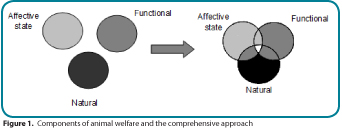
While these three approaches- ‘functional’, ‘affective states’ and ‘natural’- can be used separately, when used alone they run the risk of jeopardizing other components of animal welfare. Rather than placing our emphasis on any one component of animal welfare, we should look for systems that overlap (see Figure 1), and meet a comprehensive definition: a system in which an animal functions well, in which positive feelings outweigh negative, and in which it can express its natural behaviour in an effective manner.
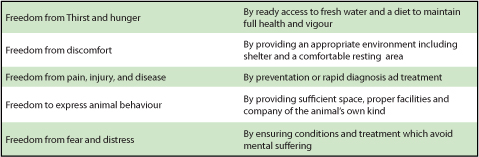
This comprehensive definition of animal welfare meets the approval of most members of society. It is also evident in the Five Freedoms(Table 1), which are accepted guidelines for animal well-being used by many animal production organizations. In the current revision process for Canadian Codes of Practice, for pigs and other species, the mandate includes this comprehensive approach. The challenge to modern producers will be to achieve these goals in a production system that is also efficient and profitable. From a research perspective, the challenge to scientists at the Prairie Swine Centre is to identify management practices that can optimize animal welfare while at the same time maintaining or improving productivity, efficiency and profitability. This is the first in a series of articles using animal welfare science to address production issues in modern pork production.
References
Fraser, D. 2008, Understanding Animal Welfare: the science in its cultural context. Wiley-Blackwell, Hoboken, NJ. Farm Animal Welfare Council, 1979. See http://www.fawc.org.uk/freedoms.htm a ‘drop-off’ in the middle of the day. Comparing these results with other studies suggests that the younger pigs were limited in the number of feeder spaces, and had to shift eating from the normal peak periods to the less intensive mid-day period.
Scientists Seek Strategies for Early Detection and Prevention of Lameness of Sows
Posted in: Pork Insight Articles, Swine Innovation by admin on November 23, 2012 | No Comments
Research examining the factors affecting the productivity of group housed sows will assist Canada’s pork producers as they consider the switch to group sow housing systems. As part of a multi-institutional, multi-disciplinary initiative being conducted on behalf of Swine Innovation-Porc, scientists with the University of Manitoba, the University of Saskatchewan, the Prairie Swine Centre, the University of Guelph and Agriculture and Agri-Food Canada are examining the productivity of sows depending on their housing system, the role of temperament in the ability of sows to behave in groups, the impact of calcium and phosphorus on lameness, the role of parity and the use of infrared to detect lameness. Dr. Nicolas Devillers, a research scientist pig behavior and welfare with Agriculture and Agri-Food Canada, notes there’s an overall move around the world to group housing systems. Clip-Dr. Nicolas Devillers-Agriculture and Agri-Food Canada: We hope it will be useful to producers because it will give them information first on what are the best housing systems that can be used without affecting productivity of sows and what are the consequences of the different choices for the different systems, for example, for the floor on the longevity of sows. This is better information for producers, if they want to use group housing systems, to choose the best system. So we will have indicators of lameness. These indicators, for the moment, are measured with quite complicated techniques but we hope to be able to apply them on farm and to give producers some tools to be able to detect lameness earlier and to develop some strategies to reduce the occurrence of lameness in sows. Dr. Devillers says the results could be used, for example, by veterinarians to diagnose lameness or for quality assurance programs as welfare indicators. He says the data is now being analyzed, the first reports should be available in 2013 and will be communicated by the Canadian Swine Research and Development Cluster through it’s web site at SwineInnovationPorc.Ca. For Farmscape.Ca, I’m Bruce Cochrane.
Reducing Costs Feeding Canola Meal
Posted in: Press Releases, Swine Innovation by admin on November 21, 2012 | No Comments
When feed exceeds 72% of pork production cost, it forces us to explore ways to reduce feed costs beyond desperation. Recent work funded through the Canola Cluster led by Eduardo Beltranena at Alberta Agriculture and Rural Development explored opportunities for reducing feed cost feeding conventional solvent-extracted canola meal at unusually high inclusions. “We went beyond producers’ comfort level” says Beltranena.
In the past, canola meal was fed at conservative levels due to palatability issues that reduced feed intake. Over the last 30 years plant breeders have bred canola varieties containing progressively lower levels of glucosinolates. Canola meal produced today typically tests 5 to 6 instead of 30 µmol/g before that was the threshold to call it ‘canola’ instead of ‘rapeseed’. “We have tested loads as low as 2” says Eduardo. “The bitter taste imparted by glucosinolates is no longer a palatability concern even at today’s high canola meal inclusion in pig and poultry diets”.
The other issue feeding canola meal to pigs is a relative high fibre content that limits its dietary energy value. “We now formulate diets on net energy instead of metabolizable or digestible energy basis. We better account now for the increase in heat production resulting from feeding increasing inclusion of high protein, high fibrous feedstuffs like canola meal, distillers dried grains with solubles (DDGS) or millrun. We blamed the ingredient instead of the energy system before for the drop in growth performance due to incremental inclusions. Now formulating diets on net energy basis results in more predictable growth”. We have proven so in 3 recent studies feeding high inclusions of solvent-extracted canola meal:
In the first study, we fed increasing inclusions of canola meal in substitution for soybean meal to weaned pigs. Feeding up to 20% canola meal did not affect daily feed disappearance, weight gain, and final trial pig weight. Weaned pigs showed a tendency for reduced feed efficiency due to increasing fibre content.
A second experiment involving 1,100 hogs examined increasing inclusion of canola meal (0 – 24%) in growout diets containing 15% DDGS. Hogs fed 24% canola meal reached market weight only 3 days later than controls, with no impact on carcass weight, dressing percent, backfat, loin depth, pork yield or index.
A third commercial-scale trial with 1,100 hogs pushed canola meal inclusion further to 30% with 20% DDGS. Feed disappearance and weigh gain were reduced by 81 g/day and 9 g/day for every 10% increase in canola meal inclusion. Number of days to market weight increased by 1, carcass weight was reduced by 0.46kg, dressing percent dropped 0.4 points, and loin depth was reduced by 0.5 mm for every 10% increase in canola meal inclusion. However, hogs consumed up to 50% local coproducts instead of imported soybean meal without major reductions on hog growth performance or carcass traits.
Benefit to the Producer
It is thus feasible feeding up to 20% solvent-extracted canola meal to weaned pigs and 30% with 20% wheat DDGS in commercial hog diets formulated on net energy and digestible amino acid basis. Canola and DDGS inclusion rates will fluctuate with commodity cost and should be routinely optimized by least cost formulation. Feeding these fibrous coproducts increases gut weight at evisceration. Producers thus need to market hogs 1 – 2kg heavier live weight to achieve target carcass weight.